The world must produce less plastic

This is a translation of an op-ed first published in Norwegian in Dagsavisen.
By Marie Hebrok and Nina Heidenstrøm
Despite mounting concern about excessive plastic consumption, global industry continues to flood the market with plastic products. At the same time, consumers are urged to swap plastic spatulas for wooden ones and plastic bottles for steel. Responsibility is thus shifted onto individuals rather than the systems that drive production. Consumers are expected to solve the problem through everyday choices, while the structures of production, distribution, and regulation remain largely unchanged. The result is a stark imbalance between the responsibility people are assigned and the power they actually have to effect change. It is like trying to empty a bathtub with a teaspoon while the tap is running at full force.
News that Norway tops the Nordic statistics for plastic consumption has surprised many. It clashes with the country’s self-image as a leader in environmental and sustainability issues. One explanation is that plastic is embedded in virtually every aspect of modern life. At the same time, Norway’s per capita consumption is significantly higher than that of its neighboring countries—and among the highest in Europe.
Plastic has shifted from being a symbol of modernity to becoming a global threat. It pollutes coastlines, harms wildlife, and accumulates in our bodies. The average person eats, drinks, and inhales between 78,000 and 211,000 microplastic particles each year, and chemicals associated with plastics are linked to hundreds of thousands of deaths annually. After decades of explosive growth in plastic production, consumers are now bombarded with messages urging them to recycle more, replace plastic items, and choose reusable alternatives over single-use products. The result is anxiety and a sense of powerlessness. For does it truly reduce plastic pollution if we exchange a plastic spatula for a wooden one, or a plastic bottle for a steel one? The answer is no—so long as overall production continues to rise. The OECD estimates that global plastic use will triple by 2060 under a business-as-usual scenario.
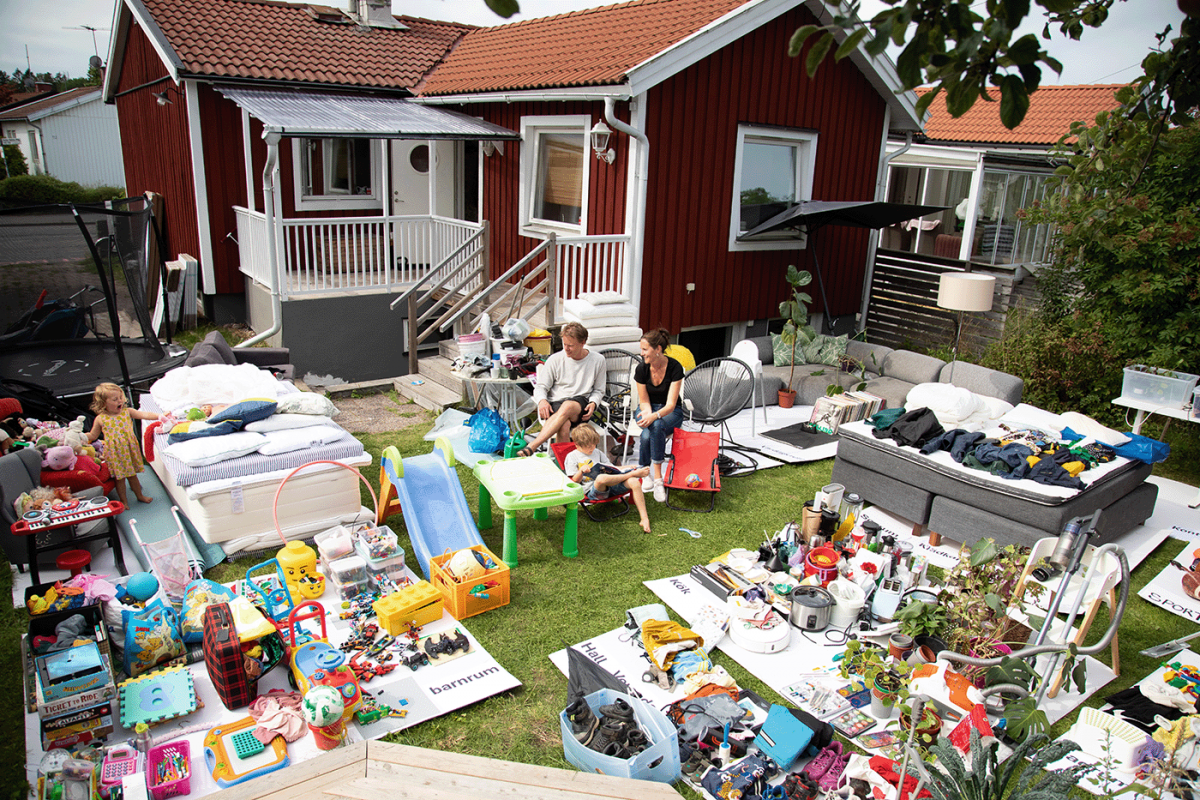
Plastic enables modern life, yet it also poses profound risks. This is the core dilemma: plastic is both indispensable and deeply problematic at the same time. In the research project REDUCE, we have examined plastic’s role in everyday life and found it woven into nearly everything we do. Plastic is far more than packaging, kitchen utensils, straws, and takeaway cups; it underpins the infrastructure of contemporary living. As physician Kaveh Rashidi notes, most of us are likely wearing microplastics and applying them to our skin as well. In the experiment Plastbanterna, conducted by our project partners at the Royal Institute of Technology (KTH) in Stockholm, a family removed all plastic from their home to explore what daily life without it would look like. Very little remained. The entire contents of the house filled their garden.
The goal is not to eliminate plastic entirely, but to use it wisely and drastically reduce the volumes in circulation. Plastic is indispensable in many contexts—from medical hygiene to lightweight, waterproof materials—but it is produced and used far beyond what is necessary. Consumers depend on plastic to live modern lives, yet they are largely powerless in the face of an industry that continues to expand production. Switching from a plastic spatula to a wooden one does not eliminate plastic; it merely shifts it to another product category.
When public debate focuses narrowly on consumption, production slips into the blind spot. The fundamental problem is scale. The enormous and ever-growing volumes of plastic produced and distributed globally transform what was once hailed as a technological breakthrough into a major environmental and public health crisis. In 2022, the United Nations Environment Assembly adopted a resolution to develop a legally binding global plastics treaty. Yet after five rounds of negotiations, no agreement has been reached. The central conflict concerns ambition: many countries advocate reducing plastic production, while oil-producing states seek to limit the treaty to waste management and voluntary measures. Norway has assumed a leadership role in the High Ambition Coalition, which calls for production cuts. Author and chemist Alexander H. Sandtorv argues that Norway must go further—we must put our own house in order and acknowledge that our oil helps fuel the plastic industry. As one of the world’s largest exporters of raw materials for plastic production, Norway should assess how it can contribute to reducing global output.
We can no longer ignore the fact that solving the plastic crisis requires producing less plastic. Governments must regulate the industry more firmly, and both producers and consumers must rethink how modern life can be lived just as well—or better—with far less plastic. Wooden spatulas alone will not save the world.